Disclosure: we may earn a commission from qualifying purchases at no extra cost to you. As an Amazon Associate I earn from qualifying purchases. Learn more.
If your mouth itches every time you eat a raw apple, and you also sneeze your way through spring, birch pollen may be the link. Birch is one of the most common causes of oral allergy syndrome, also called pollen food allergy syndrome (PFAS), and its food list includes some of the most popular fruits and snacks around.
This guide covers which foods cross-react with birch pollen, why a peeled or baked apple may be fine when a raw one isn’t, the special caution with nuts, and when to talk with an allergist. New to the topic? Start with our overview of oral allergy syndrome.
Key takeaways
- Up to 50 to 75% of adults allergic to birch pollen get an itchy mouth or throat from foods like apple or celery (AAAAI).
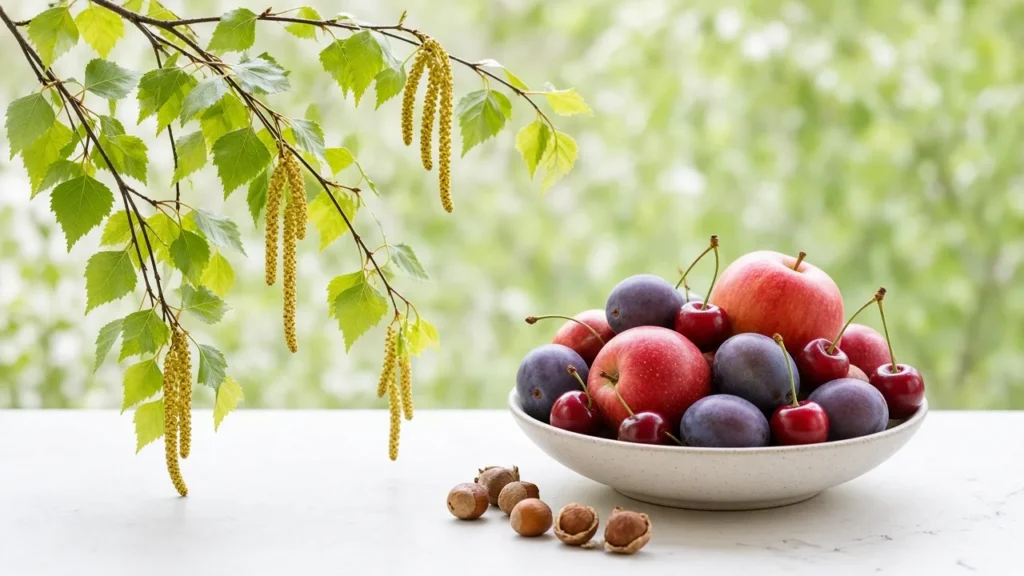
- Common birch-related foods include apple, almond, carrot, celery, cherry, hazelnut, kiwi, peach, pear and plum (ACAAI).
- Symptoms are often worse during tree pollen season, which usually runs February to April (AAAAI) (AAFA).
- Cooking, peeling or choosing canned fruit can prevent many reactions (AAAAI).
- Mouth itching from nuts should be checked by an allergist (AAAAI).
Why Birch Pollen Affects What You Eat
Birch trees release huge amounts of pollen in spring. If you’re allergic to it, your immune system has learned to attack certain birch proteins. The trouble is that some fruits, vegetables and nuts contain proteins with a very similar shape. When you eat those foods raw, your immune system can mistake them for pollen and react in your mouth and throat. Allergists call this cross-reactivity (AAAAI).
AAFA notes that birch and alder tree pollen, along with ragweed, cause many PFAS food reactions (AAFA). AAAAI puts a number on it: this happens in up to 50 to 75% of adults allergic to birch pollen (AAAAI). If you have spring hay fever and a mysteriously itchy mouth, you’re in large company.
Foods That Cross-React With Birch Pollen
ACAAI lists these foods as commonly associated with birch pollen allergy (ACAAI). AAAAI also mentions pitted fruits, carrot, peanut, almond and hazelnut (AAAAI).
| Food group | Common birch-related triggers | Often easier to eat |
|---|---|---|
| Tree fruits | Apple, pear | Applesauce, baked apples, canned pears |
| Pitted (stone) fruits | Cherry, peach, plum | Canned or cooked peaches, cherry pie filling |
| Other fruit | Kiwi | Cooked into jams or sauces |
| Vegetables | Carrot, celery | Cooked carrots, celery in soups |
| Nuts | Almond, hazelnut | Ask an allergist first |
Not everyone with a birch allergy reacts to all of these, and many people react to only one or two (ACAAI). AAAAI notes that some people react to only certain varieties of a fruit, such as one type of apple (AAAAI). That’s worth knowing if a favorite variety bothers you but another doesn’t.
What a Birch-Related Reaction Feels Like
Typical symptoms are an itchy mouth, a scratchy throat, or swelling of the lips, mouth, tongue and throat. Some people get itchy ears or hives around the mouth (ACAAI). Symptoms usually start right after eating the raw food (AAAAI) and fade quickly once the food is swallowed or removed (ACAAI).
- Itching or tingling of the lips, tongue or roof of the mouth
- A scratchy or tight feeling in the throat
- Mild lip swelling
- Itchy ears
These mild symptoms are the usual pattern. Severe reactions are rare, but they do happen. ACAAI cites a study where PFAS progressed beyond the mouth in nearly 9% of patients and to anaphylactic shock in 1.7% (ACAAI).
When it’s an emergency
Call 911 right away if a food reaction spreads beyond your mouth or comes with trouble breathing or swallowing, throat tightness, a hoarse or whispered voice, hives across your body, vomiting, dizziness or fainting. These can be signs of anaphylaxis, which needs emergency care (MedlinePlus). If you’ve been prescribed epinephrine, use it immediately, then get emergency help (MedlinePlus).
The Nut Question: Why Allergists Want to Know
Almond and hazelnut are on the birch list, and AAAAI says even peanuts may cause mouth itching in people with birch pollen allergy. But AAAAI also warns that if you notice mouth itching with nuts, you should see an allergist, because mild mouth symptoms may signal a more serious allergic reaction to nuts (AAAAI).
ACAAI likewise lists symptoms with high-risk foods such as peanut or tree nuts as a reason your allergist may prescribe an epinephrine auto-injector (ACAAI). In other words, don’t assume a nut reaction is “just” OAS. Get it checked before you keep eating them.
Why Spring Makes It Worse
OAS can happen any time of year, but AAAAI notes it often gets worse during the pollen season of the pollen involved (AAAAI). For birch and other trees, that’s spring. AAFA says tree pollen season usually runs from February to April, though in some parts of the country trees start as early as December or January (AAFA).
That timing means an apple you eat in October might be fine while the same apple in April makes your mouth itch. If that’s your pattern, consider switching to cooked or canned versions of trigger foods during tree season. Check daily tree pollen forecasts on our city pollen pages and read our spring allergies guide for more on the season.
How to Keep Eating Fruit Safely
The proteins behind birch-related reactions are easily damaged by heat. ACAAI says most people with PFAS can eat the same fruits and vegetables cooked, because heating distorts the proteins so the immune system no longer recognizes them (ACAAI). AAAAI offers several practical tips (AAAAI):
- Bake or microwave. High temperatures break down the proteins. Baked apples, poached pears and roasted carrots are often fine.
- Choose canned. Canned peaches, pears and cherries may limit the reaction.
- Peel it. The offending protein is often concentrated in the skin, so peeled apples and pears may cause fewer symptoms.
- Avoid raw triggers in spring, when symptoms tend to peak.
Smart swaps for birch season
Swap a raw apple for unsweetened applesauce, fresh peaches for canned, raw carrot sticks for roasted carrots, and a fresh cherry snack for cherries cooked into oatmeal. You still get the fiber and flavor without the itch.
One caution: if a cooked food also causes symptoms, AAAAI lists that as a reason to see your doctor (AAAAI). It may mean you have a different kind of food allergy.
How Doctors Confirm a Birch-Food Link
There isn’t one definitive test for OAS. People with it often have a positive skin or blood test for a specific pollen, along with a history of symptoms after eating the foods (AAAAI). ACAAI says an allergist may also use skin prick tests and oral food challenges with the raw fruit or vegetable (ACAAI).
Before your visit, jot down which foods bother you, whether they were raw or cooked, peeled or not, and what time of year it was. Learn more in our allergy testing guide and our article on skin prick vs. blood tests.
Treatment Options
Most birch-related mouth symptoms settle on their own within minutes, so ACAAI says treatment usually isn’t needed for the reaction itself (ACAAI). The bigger opportunity is treating the birch pollen allergy that drives it.
- Spring hay fever medicines. Starting treatment before tree season can make spring easier overall. AAFA says most allergy treatments work best when started at least 2 weeks before pollen season begins (AAFA). See how to start allergy meds before pollen season.
- Allergy shots. AAAAI notes some studies have shown allergy shots can improve OAS symptoms (AAAAI). Our tree pollen allergy treatment guide explains how immunotherapy works.
- Epinephrine, if prescribed. If your allergist thinks you’re at risk for a severe reaction, they may prescribe an epinephrine auto-injector (ACAAI). MedlinePlus advises using it right away for a severe reaction and then going to the hospital (MedlinePlus).
When to See an Allergist
Make an appointment if your throat feels tight or uncomfortable, if symptoms are getting worse, if cooked foods or nuts cause symptoms, or if you’ve had hives, vomiting or trouble breathing after eating (AAAAI). Find a board-certified specialist near you in our allergist directory.
Everyday Tips: Lunches, Restaurants and Smoothies
Raw birch-related foods show up in places you might not expect. Fruit salads, green smoothies, juice bars, salad bars, veggie trays with carrot and celery sticks, trail mixes and nut butters can all contain triggers. A few habits make life easier:
- Read ingredient lists on smoothies, salads and snack packs, and ask restaurants whether fruit or vegetables are raw or cooked.
- Pack cooked or canned fruit for school and work lunches during spring.
- If you’re trying a new raw fruit, start with a small bite at home rather than a big serving away from home. MedlinePlus notes that reaction severity can depend on how much you eat (MedlinePlus).
- Keep your food log on your phone so you can show your allergist exactly what happened.
Birch Pollen and Your Home
Cutting down on the pollen you breathe can make tree season more comfortable, even if it doesn’t stop food reactions. Keep windows closed on high-count days, shower after spending time outdoors and run a HEPA purifier in the bedroom. Our air purifier guide and pollen mask guide have picks.
What actually helps
We may earn a commission from qualifying purchases. Read our affiliate disclosure.
HEPA air purifier & filters
A portable HEPA purifier sized to the room can lower airborne particles such as pollen and dust; it only works if you replace filters on schedule. (EPA: Guide to Air Cleaners in the Home)
See the Levoit Core 300 on AmazonSaline nasal rinse kit
Rinsing with saline can clear pollen from the nose; use distilled, sterile or boiled-then-cooled water, never plain tap water. (FDA: Is rinsing your sinuses with neti pots safe?)
See the NeilMed Sinus Rinse kit on AmazonN95 mask for yard work
For mowing, raking or gardening in pollen season, a well-fitted N95 respirator filters airborne particles far better than a loose face mask. Check with a doctor first if you have a breathing condition. (FDA: N95 Respirators and Face Masks)
See the 3M Aura 9205+ N95 on AmazonMore on pollen and food: Grass pollen food allergy, Oral allergy syndrome and Ragweed food allergy.
Written by: SeasonalAllergies.org Editorial Team (October 27, 2026)
This article is for general education and is not medical advice. Food reactions can be serious. Talk with your doctor or a board-certified allergist before avoiding or reintroducing foods, especially for children. Call 911 for trouble breathing, throat tightness, a hoarse voice, fainting or any reaction beyond the mouth.
Birch Pollen Food Allergy FAQs
Why do raw apples make my mouth itch?
If you’re allergic to birch pollen, proteins in raw apple can look like birch proteins to your immune system. This happens in up to 50 to 75% of adults with birch allergy (AAAAI).
Which foods cross-react with birch pollen?
Common ones are apple, almond, carrot, celery, cherry, hazelnut, kiwi, peach, pear and plum (ACAAI).
Can I eat cooked apples if raw ones bother me?
Often, yes. Heat changes the proteins, so many people tolerate cooked versions (ACAAI).
Does peeling fruit help?
It may. AAAAI says the protein is often concentrated in the skin (AAAAI).
Is birch-related nut itching dangerous?
It can be a warning sign. AAAAI says to see an allergist if nuts make your mouth itch (AAAAI).
When is birch pollen season?
Tree pollen usually runs February to April, and earlier in some regions (AAFA).
Related Guides
Local pollen and allergist guides
Pollen seasons and triggers change by city. See what is in the air near you and where to find an allergist.
City pollen guides
State guides
Sources
- American Academy of Allergy, Asthma & Immunology. “Oral Allergy Syndrome (OAS) or Pollen Food Syndrome.”
https://www.aaaai.org/tools-for-the-public/conditions-library/allergies/oral-allergy-syndrome-(oas) - American College of Allergy, Asthma and Immunology. “Pollen Food Allergy Syndrome.”
https://acaai.org/allergies/allergic-conditions/food/oral-allergy-syndrome/ - Asthma and Allergy Foundation of America. “Pollen Allergy.”
https://aafa.org/allergies/types-of-allergies/pollen-allergy/ - MedlinePlus Medical Encyclopedia. “Anaphylaxis.” U.S. National Library of Medicine.
https://medlineplus.gov/ency/article/000844.htm - MedlinePlus Medical Encyclopedia. “Food allergy.” U.S. National Library of Medicine.
https://medlineplus.gov/ency/article/000817.htm
🌼 Free pollen alerts
Short, sourced alerts when oak, grass, ragweed or mold season picks up near you. Sign up and get our free printable US and Florida pollen calendar.
Free printable pollen calendar included. No spam. Unsubscribe anytime.