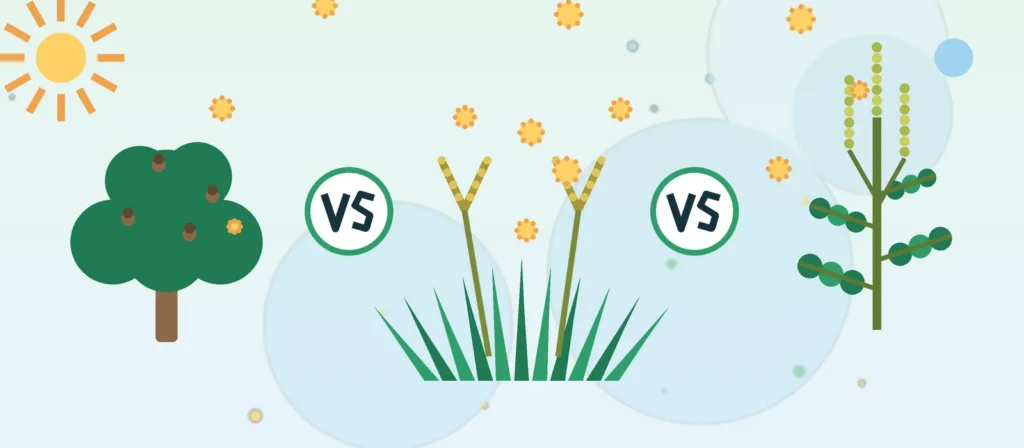
If you sneeze every spring, someone has probably told you that you have a pollen allergy. That is true, but it is only half the story. Pollen allergy is really three different allergies that tend to show up at different times of year: tree pollen, grass pollen and weed pollen. Knowing which one bothers you helps you predict your bad weeks, time your medicine and decide whether testing or allergy shots make sense. This guide compares the three side by side, explains how to tell them apart and covers what changes, and what does not, in how each one is treated.
Key takeaways
- Most allergy-causing pollen comes from trees, grasses and weeds, because their pollen is small, light and dry and travels on the wind (AAFA).
- Across much of the U.S., trees lead in late winter and spring, grasses take over from April through early June, and weeds such as ragweed run from August to the first hard frost (AAFA).
- In Florida and other warm regions, the seasons are longer and overlap, and Bermuda grass can pollinate year-round in subtropical parts of the state (UF/IFAS).
- The everyday medicines are largely the same for all three, but FDA-approved allergy tablets exist only for certain grass and ragweed pollens (plus dust mites), not for tree pollen (ACAAI).
Why Trees, Grasses and Weeds Cause Most Pollen Allergies
Plants release pollen to fertilize other plants of the same species. The ones that cause hay fever, which doctors call seasonal allergic rhinitis, are mostly wind-pollinated trees, grasses and weeds. Their pollen grains are small, light and dry, so they drift into your eyes, nose and lungs (AAFA). Plants that rely on insects to carry pollen, such as roses and cherry and pear trees, do not cause allergic rhinitis (AAFA).
This explains a common mix-up. The thick yellow dust you see on cars is not always the problem. In Florida, UF/IFAS notes that pine pollen, famous for coating everything yellow, is low-allergenic, and that goldenrod, often blamed for fall sneezing, has heavy, sticky pollen that does not blow in the wind. Ragweed is the more clinically significant weed (UF/IFAS). For the basics of how pollen triggers symptoms, see our pollen allergies overview.
Tree vs. Grass vs. Weed Pollen at a Glance
The table below summarizes typical U.S. timing and common culprits. Exact dates shift by region and by year.
| Tree pollen | Grass pollen | Weed pollen | |
|---|---|---|---|
| Typical season | February to April; some regions start as early as December or January | April to early June; year-round in warmer areas such as California, Texas and the South | August to the first hard frost |
| Common culprits | Oak, birch, maple, elm, cedar and juniper, hickory, pecan, walnut, ash, cottonwood | Bahia, Bermuda, Johnson, Kentucky blue, orchard, rye, fescue, timothy | Ragweed, mugwort, pigweed, lamb’s-quarters, sagebrush, Russian thistle |
| Good to know | First pollen of the year and the main source of spring symptoms | Hundreds of grass types exist, but only a few cause allergies | Ragweed pollen can travel hundreds of miles in the air |
Table based on AAFA’s pollen allergy guide (AAFA). For month-by-month timing where you live, see our pollen calendar by month and region.
Tree Pollen: The First Wave
Tree pollen is the first pollen to appear each year in the United States and is responsible for most spring allergy symptoms. Trees release the most pollen from February through April, but in the South they may start as early as December or January and peak more than once a year (AAFA). NIEHS adds that trees release pollen as early as January in Southern states and as late as May or June in Northern states, and that tree pollen can travel miles from its source (NIEHS).
Trees that cause the most symptoms include alder, ash, birch, cedar, cottonwood, elm, hickory, juniper, maple, mulberry, oak, olive, pecan, poplar, walnut and willow (AAFA). In Florida, trees account for about 80% of airborne pollen, and oak is one of the most allergenic. Oak usually peaks from February to May, though some areas see high counts as early as December (UF/IFAS). Our guides to oak pollen allergy in Florida and pine and wax myrtle pollen go deeper on those trees.
Tree pollen has one more quirk. Birch and alder pollen cause many reactions in pollen-food allergy syndrome, where raw fruits such as apples, cherries and pears make your mouth itch (AAFA). Read more in our article on oral allergy syndrome. If trees are your main problem, our tree pollen allergy treatment guide covers your options.
Grass Pollen: Late Spring and Summer
Grasses cause most late spring and summer pollen symptoms. In most of the country, grass pollen is highest from April through early June, but it can be found year-round in warmer areas like California, Texas and the South (AAFA). More than 1,000 species of grass grow in North America, yet only a few cause allergies (NIEHS).
Allergists often split these into two groups. Northern grasses include timothy, Kentucky blue, Johnson, rye and fescue. Southern grasses include Bermuda and Bahia (AAAAI). That split matters in the South. Bahiagrass is the most abundant grass in Florida and is highly allergenic, and Bermudagrass pollinates year-round in subtropical parts of the state (UF/IFAS).
Grass allergy usually shows up as sneezing, a runny or stuffy nose, itchy and watery eyes and sometimes asthma. Some people also get hives after touching grass, though this is much less common (AAAAI). If you are not sure whether your symptoms are grass-related, our grass pollen allergy treatment guide walks through testing and treatment.
Weed Pollen: Late Summer and Fall
Weed pollen arrives in late summer and fall, and ragweed is the biggest offender. Ragweed grows throughout the U.S., especially in areas disturbed by people, and its pollen can travel hundreds of miles in the air, which makes it hard to avoid (AAFA). A single ragweed plant only lives one season, but it can produce up to 1 billion pollen grains (AAAAI).
NIEHS says the ragweed season runs from August to November, with levels typically peaking in mid-September in many parts of the country (NIEHS). AAAAI notes that in many areas, fall symptoms that used to start in mid-August now begin in early August and last through October (AAAAI). Other weeds that can cause symptoms include mugwort, pigweed, lamb’s-quarters, cocklebur, sagebrush, Russian thistle and tumbleweed (AAFA). In Florida, dog fennel and pigweed are also highly allergenic, and weeds can pollinate in spring, summer, fall and even winter (UF/IFAS).
For the full fall picture, see our guide to ragweed allergy treatment and season dates.
How to Tell Which Pollen Is Bothering You
The three allergies cause the same symptoms: runny or stuffy nose, sneezing, postnasal drip, itchy eyes, nose and mouth, and sometimes coughing or wheezing. What differs is the timing, because you only have symptoms when the pollen you are allergic to is in the air (AAFA). A few clues can narrow it down:
- Track your worst weeks. Symptoms that start in late winter or early spring point to trees. A late spring and early summer peak points to grass. Trouble from August into fall points to weeds.
- Watch for overlap. Tree pollen often overlaps with grass pollen in spring and summer (AAFA), so a long spring season may mean you react to both.
- Check pollen counts, not just forecasts. A pollen count measures pollen captured by an air sampler, while a forecast is an estimate. Counts, such as those from AAAAI’s National Allergy Bureau, can help you see which pollen type is present when you feel worst (AAFA).
- Get tested. Skin prick testing and specific IgE blood tests can show which pollens you are sensitized to. A positive result does not prove that pollen causes your symptoms, so your doctor reads it alongside your history (AAFA).
Our allergy testing guide explains what each test involves and how to prepare.
Does the Type of Pollen Change Treatment?
For everyday relief, not much. Common antihistamines and nasal steroid sprays can reduce hay fever symptoms (NIEHS), whichever pollen sets yours off. What changes is when you start. Most allergy treatments work best when started at least two weeks before your pollen season begins (AAFA), so knowing whether you are a tree, grass or weed person tells you when to begin. Our guide on how to start allergy meds before pollen season has a simple plan.
The pollen type matters more for long-term treatment:
- Allergy shots can be built around the specific pollens you react to, which helps if you are allergic to more than one type.
- Allergy tablets that dissolve under the tongue are available only for a few allergens: certain grass and ragweed pollens and house dust mite (ACAAI). AAFA lists the grass tablets Grastek and Oralair and the ragweed tablet Ragwitek (AAFA). There is no FDA-approved tablet for tree pollen.
Cut exposure to all three
- Keep windows closed at home and in the car during your season, and use air conditioning instead of window or attic fans (NIEHS).
- Save outdoor activities for late afternoon or after a heavy rain, when pollen levels are lower (NIEHS).
- Shower before bed and change clothes after time outdoors to keep pollen off your bedding (AAFA).
- Wear a mask when mowing, or ask someone else to mow, if grass is your trigger (NIEHS).
Pollen Seasons Are Getting Longer
Whichever pollen you react to, the season may be stretching. NIEHS reports that the annual average of daily airborne pollen rose 46% between 1994-2000 and 2001-2010, and that the pollen season lengthened by as much as 13 to 27 days in the northern United States between 1995 and 2009 (NIEHS). For allergy sufferers, that can mean an earlier start and a later finish. If you are in the South, our Florida pollen guide shows how long tree, grass and weed seasons run there.
If medicines are not controlling your symptoms, or your season seems to keep growing, an allergist can confirm your triggers and talk through allergy shots or tablets. Browse our Find an Allergist directory to find one near you.
Written by: SeasonalAllergies.org Editorial Team (November 16, 2026)
This article is for general education and is not medical advice. Talk with your doctor or an allergist about your symptoms before starting, stopping or changing any treatment.
Tree vs. Grass vs. Weed Pollen FAQs
Which pollen is worst for allergies?
It depends on what you are allergic to and where you live. Tree pollen causes most spring symptoms, grasses cause most late spring and summer symptoms, and ragweed is the main cause of fall symptoms (AAFA). Testing can show which one affects you.
Can you be allergic to tree, grass and weed pollen at the same time?
Yes. Many people react to more than one type, and tree and grass seasons often overlap in spring and summer (AAFA). That is one reason allergists may suggest allergy shots, which can include several allergens.
Is pine pollen a common allergy trigger?
Usually not. Pine pollen is very visible, but UF/IFAS describes it as low-allergenic. In Florida, oak, other trees, Bahia and Bermuda grass, and ragweed are bigger triggers (UF/IFAS).
When is ragweed season?
NIEHS says ragweed season runs from August to November, typically peaking in mid-September in many areas (NIEHS). In warm parts of the South, weeds can pollinate for much longer.
Related Guides
Local pollen and allergist guides
Pollen seasons and triggers change by city. See what is in the air near you and where to find an allergist.
City pollen guides
Sources
- Asthma and Allergy Foundation of America. “Pollen Allergy.”
https://aafa.org/allergies/types-of-allergies/pollen-allergy/ - UF/IFAS Gardening Solutions, University of Florida. “Pollen and Allergies.”
https://gardeningsolutions.ifas.ufl.edu/design/outdoor-living/pollen-and-allergies/ - American College of Allergy, Asthma & Immunology. “Hay Fever.”
https://acaai.org/allergies/allergic-conditions/hay-fever/ - National Institute of Environmental Health Sciences. “Pollen.”
https://www.niehs.nih.gov/health/topics/agents/allergens/pollen - American Academy of Allergy, Asthma & Immunology. “Mowing Down Your Grass Allergies.”
https://www.aaaai.org/tools-for-the-public/conditions-library/allergies/mowing-down-your-grass-allergies - American Academy of Allergy, Asthma & Immunology. “Ragweed Allergy: Plants Packed with Pollen.”
https://www.aaaai.org/tools-for-the-public/conditions-library/allergies/ragweed
🌼 Free pollen alerts
Short, sourced alerts when oak, grass, ragweed or mold season picks up near you. Sign up and get our free printable US and Florida pollen calendar.
Free printable pollen calendar included. No spam. Unsubscribe anytime.