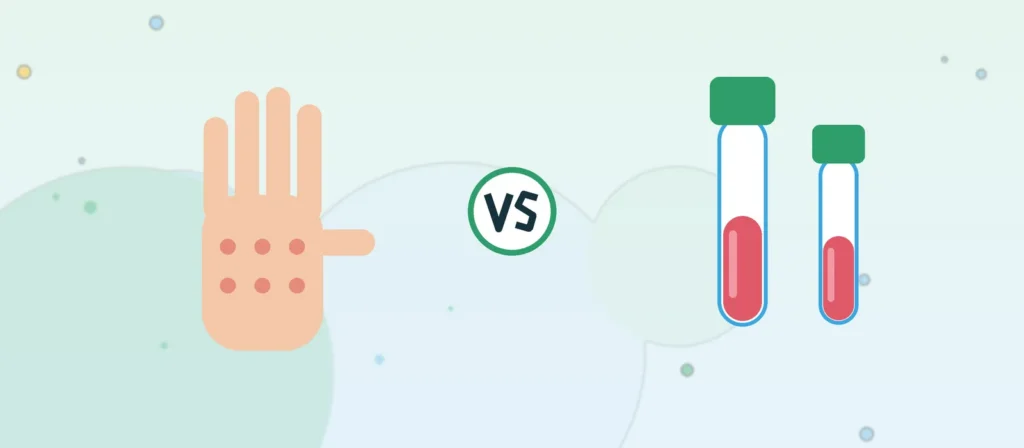
If you’ve been sneezing through the season or reacting to a food and you’re finally getting tested, you’ll probably hear about two options: a skin prick test or a blood test. Both look for the same allergy antibody, but they work differently, take different amounts of time, and fit different situations. Here’s how they compare, which one allergists usually start with, and what the results can and can’t tell you.
Blood tests also help diagnose alpha-gal syndrome (an IgE test for alpha-gal) and seafood and shellfish allergy testing.
For an overview of every type of allergy test, including patch tests and food challenges, see our allergy testing guide.
Key takeaways
- Skin testing is the preferred method used by trained allergists and is usually the most accurate (ACAAI).
- Skin prick results show up in about 15 to 20 minutes, while blood test results take longer (MedlinePlus) (AAAAI).
- Blood tests are generally used when skin tests might be unsafe or won’t work, such as with certain skin conditions or medicines (AAAAI).
- Neither test diagnoses an allergy by itself. Results have to be read together with your medical history (ACAAI).
The Short Answer
For most people with suspected seasonal, pet, dust or food allergies, an allergist will reach for a skin prick test first. The American College of Allergy, Asthma and Immunology (ACAAI) calls allergy skin testing the gold standard and says it’s the preferred method used by trained allergists and usually the most accurate. Skin tests also give fast results and usually cost less than blood tests (ACAAI).
A blood test is the go-to when skin testing isn’t a good fit. The American Academy of Allergy, Asthma & Immunology (AAAAI) says IgE blood tests are generally used when skin tests might be unsafe or won’t work, for example if you take certain medicines or have a skin condition that may interfere (AAAAI). ACAAI notes that your allergist may want skin testing, blood testing or both (ACAAI).
What Both Tests Look For
When you have an allergy, your immune system treats a harmless substance like pollen as an invader and makes antibodies called immunoglobulin E (IgE). Those antibodies set off the chemical release that causes allergy symptoms (AAAAI). Both tests are looking for signs of that IgE response to specific allergens. ACAAI says both blood and skin tests can detect sensitivity to common inhalants like pollen and dust mites, as well as to medicines, certain foods, latex, venom and other substances (ACAAI).
This is different from IgG food panels sold online, which measure a different antibody and aren’t a valid way to diagnose allergies. We explain why in IgG Food Sensitivity Tests: What the Science Says.
How a Skin Prick Test Works
A skin prick test, also called a scratch test, is the most common allergy skin test (MedlinePlus). Here’s what typically happens:
- Your provider places small drops of specific allergens on your skin, such as your forearm or back, then lightly scratches or pricks the skin through each drop (MedlinePlus).
- ACAAI says placing the allergens takes about 5 to 10 minutes. They usually go on the forearm in adults and on the back in children (ACAAI).
- If you’re allergic to one of them, a small red bump called a wheal appears within about 15 to 20 minutes (MedlinePlus). AAAAI describes it as looking and feeling like a mosquito bite (AAAAI).
- The small hives typically go away within 30 minutes, and you generally won’t have other symptoms (AAAAI).
If prick tests are negative but your doctor still suspects an allergy, a more sensitive intradermal test may be used, in which a small amount of allergen is injected within the skin (AAAAI). Intradermal tests are used for things like insect stings and penicillin, but not for food allergies (MedlinePlus).
The test isn’t considered painful, though it may hurt slightly, and the most common side effect is red, itchy skin at the test spots (MedlinePlus) (ACAAI). In very rare cases a skin test can cause anaphylaxis, which is why it must be done in an office where emergency equipment is available (MedlinePlus).
How an Allergy Blood Test Works
An allergy blood test measures IgE in your blood. A total IgE test measures the overall amount, while a specific IgE test measures how much IgE your body makes in response to a single allergen, with a separate test for each allergen (MedlinePlus). You may see it listed under other names, including specific IgE, RAST, CAP or ELISA (MedlinePlus).
A health care professional draws blood from a vein in your arm, which usually takes less than five minutes (MedlinePlus). The sample goes to a lab, so results aren’t available as quickly as with skin tests (AAAAI). For food allergy blood tests, ACAAI says results typically take about one to two weeks and are reported as a number (ACAAI). The risks are small: slight pain or bruising where the needle went in (MedlinePlus), and a few people may faint during a blood draw (ACAAI).
Skin Prick vs. Blood Test: Side by Side
| Skin prick test | Blood (specific IgE) test | |
|---|---|---|
| Where it’s done | An allergist’s office (ACAAI) | A blood draw from a vein in your arm (MedlinePlus) |
| Time to results | About 15 to 20 minutes (MedlinePlus) | Longer; about 1 to 2 weeks for food panels (ACAAI) |
| Accuracy | Preferred method and usually the most accurate (ACAAI) | Less sensitive than skin prick tests for foods (ACAAI) |
| Cost | Usually costs less (ACAAI) | Costs more than skin tests (ACAAI) |
| Antihistamines | Must be stopped before testing (ACAAI) | ACAAI says medicine doesn’t interfere (ACAAI) |
| Main risk | Itchy bumps; very rarely a severe reaction (MedlinePlus) | Slight pain or bruising (MedlinePlus) |
When a Blood Test Is the Better Choice
MedlinePlus lists several situations where your provider may recommend a blood test instead of skin testing (MedlinePlus) (MedlinePlus):
- Skin conditions. Severe eczema or psoriasis on the arms and back, where skin tests are usually done.
- Medicines you can’t stop. Some medicines, including antihistamines and certain antidepressants, can interfere with skin test results.
- A history of severe reactions. If you’re likely to have a serious reaction to the allergens used in skin testing.
- Young children. In some cases, skin testing may be too uncomfortable for them.
Depending on your history and symptoms, your provider may order a skin test together with a blood test, or a skin test alone (MedlinePlus).
How to Prepare
Before a skin test
- Tell your allergist about every medicine you take, including over-the-counter ones (ACAAI).
- ACAAI says not to take antihistamines for 3 to 7 days before the test, and to ask your allergist exactly when to stop. Nasal steroid sprays and asthma medicines won’t interfere and are okay to keep using (ACAAI).
- Your provider may also ask about products you use on your skin and whether you’re often around animals (MedlinePlus).
Before a blood test
- No special preparation is usually needed, but tell your provider about everything you take, and don’t stop any medicine unless they tell you to (MedlinePlus).
Tip: plan around allergy season
Since antihistamines need to be stopped for several days before a skin test (ACAAI), ask your allergist how to manage symptoms in the meantime. Nasal steroid sprays won’t affect skin test results (ACAAI). If you can’t go without antihistamines, ask whether a blood test makes more sense.
What Your Results Mean
With a skin test, a red bump or swelling means you’re probably allergic to that substance, and usually the larger the reaction, the more likely you are to be allergic. No bump usually means you’re probably not allergic (MedlinePlus). With a blood test, a high specific IgE result means you may be allergic to that allergen, but the amount measured doesn’t predict how serious your allergy is (MedlinePlus). A high total IgE suggests some kind of allergy but doesn’t show what you’re allergic to (MedlinePlus).
Here’s the part that surprises a lot of people: a positive test isn’t the same as an allergy. ACAAI says many patients are sensitized to many allergens but clinically allergic to only some of them, and that even if a skin test shows you’re allergic to something, you may not react when you’re exposed to it later (ACAAI). Blood tests can also give false positives, and higher IgE can be caused by smoking or a parasitic infection. False negatives on blood tests are uncommon (MedlinePlus).
Results need context
ACAAI says blood test and skin test results alone do not diagnose allergies, and all results must be interpreted together with your medical history (ACAAI). That’s one reason AAAAI advises against allergy screening done in supermarkets or drug stores and home testing (AAAAI). More on that in Are Home Allergy Test Kits Accurate?.
What About Food Allergies?
Both tests are used for suspected food allergies, but neither is conclusive on its own. ACAAI says a positive result to a food doesn’t always mean you’ll react when you eat it, a negative result is more helpful for ruling an allergy out, and neither test can predict how severe a reaction would be (ACAAI). For foods, ACAAI notes that blood tests are less sensitive than skin prick tests (ACAAI).
When results are unclear, an allergist may recommend an oral food challenge, in which you eat gradually increasing amounts of a food under close supervision. ACAAI calls it the gold standard for food allergy diagnosis, and it should never be tried at home (ACAAI). MedlinePlus says it’s the only food allergy test that can confirm a diagnosis (MedlinePlus). ACAAI also describes a newer blood test, the basophil activation test, which looks at how your immune cells react to a food and can help when standard results are hard to interpret (ACAAI).
After the Test: Next Steps
Once your allergist knows what you react to, they’ll build a plan. ACAAI says that usually means avoiding or limiting contact with your triggers, taking medicine to relieve symptoms, and getting allergy shots if your allergist recommends them (ACAAI). Immunotherapy, given as shots or under the tongue, uses gradually increasing doses of your allergen so your immune system becomes less sensitive over time (ACAAI). Learn more on our immunotherapy page.
On cost, ACAAI says most health insurance plans cover allergy testing and treatment, and suggests asking your insurer whether you need a referral to see an allergist and which tests and medicines your plan covers (ACAAI).
If testing shows you’re at risk for anaphylaxis, you may need to carry an epinephrine auto-injector at all times (MedlinePlus). Our guide to allergy emergencies explains the warning signs.
Written by: SeasonalAllergies.org Editorial Team (October 21, 2026)
This article is for general education and is not medical advice. Talk with your doctor or a board-certified allergist about which test is right for you, and don’t stop any medicine before testing unless your provider tells you to.
Skin Prick vs. Blood Allergy Test FAQs
Which is more accurate, a skin prick test or a blood test?
ACAAI says skin testing is the preferred method used by trained allergists and is usually the most accurate (ACAAI). Blood tests are a good option when skin testing isn’t safe or practical (AAAAI).
Does a skin prick test hurt?
Not much. MedlinePlus says the test itself is not painful, and the most common side effect is red, itchy skin at the test spots (MedlinePlus). ACAAI notes it may hurt slightly (ACAAI).
Do I need to stop antihistamines before an allergy blood test?
Usually not. ACAAI says medicine doesn’t interfere with blood test results (ACAAI), but MedlinePlus advises telling your provider about everything you take and not stopping any medicine unless they tell you to (MedlinePlus).
Can a positive allergy test be wrong?
It can be misleading. ACAAI says a positive skin test doesn’t always mean you’ll react when exposed (ACAAI), and MedlinePlus says blood tests can give false positives (MedlinePlus). That’s why results are read alongside your history.
Related Guides
Local pollen and allergist guides
Pollen seasons and triggers change by city. See what is in the air near you and where to find an allergist.
City pollen guides
Sources
- American College of Allergy, Asthma and Immunology. “Testing & Diagnosis.”
https://acaai.org/allergies/testing-diagnosis/ - MedlinePlus. “Allergy Skin Test.”
https://medlineplus.gov/lab-tests/allergy-skin-test/ - American Academy of Allergy, Asthma & Immunology. “Allergy Testing.”
https://www.aaaai.org/tools-for-the-public/conditions-library/allergies/allergy-testing - MedlinePlus. “Allergy Blood Test.”
https://medlineplus.gov/lab-tests/allergy-blood-test/ - American College of Allergy, Asthma and Immunology. “Food Allergy Testing and Diagnosis.”
https://acaai.org/allergies/testing-diagnosis/food-allergy-testing-and-diagnosis/ - MedlinePlus. “Food Allergy Testing.”
https://medlineplus.gov/lab-tests/food-allergy-testing/
🌼 Free pollen alerts
Short, sourced alerts when oak, grass, ragweed or mold season picks up near you. Sign up and get our free printable US and Florida pollen calendar.
Free printable pollen calendar included. No spam. Unsubscribe anytime.