Disclosure: we may earn a commission from qualifying purchases at no extra cost to you. As an Amazon Associate I earn from qualifying purchases. Learn more.
Grass pollen is one of the most common causes of hay fever, and for some people it also turns a summer salad or a slice of melon into an itchy experience. When raw tomatoes, peaches, celery, oranges or melons make your mouth tingle, grass pollen may be the reason. This is a form of oral allergy syndrome, also called pollen food allergy syndrome (PFAS).
This guide covers which foods cross-react with grass pollen, why the timing of grass season matters, how to keep enjoying summer produce, and the warning signs that need medical attention. For the bigger picture, see our oral allergy syndrome overview.
Key takeaways
- People allergic to grass pollen may react to celery, melons, oranges, peaches and tomato (ACAAI).
- Grass pollen is most common from April through early June, but can be found year-round in warm parts of the country (AAFA).
- OAS often gets worse during the pollen season involved (AAAAI).
- Cooking, canning or peeling can reduce reactions for many foods (AAAAI).
- Reactions beyond the mouth or trouble breathing need emergency care (MedlinePlus).
How Grass Pollen Affects Food
Grass pollen contains proteins your immune system may react to if you have hay fever. Some fruits and vegetables carry proteins that look very similar. When you eat them raw, your immune system may mistake those food proteins for grass pollen and cause itching or swelling in your mouth and throat. Allergists call this cross-reactivity (AAAAI).
AAFA explains that PFAS happens because some tree, grass or weed pollens are similar to proteins in some fruits, vegetables and nuts, and the immune system can’t tell the difference (AAFA). Birch and ragweed get most of the attention, but grass has its own food list.
Foods That Cross-React With Grass Pollen
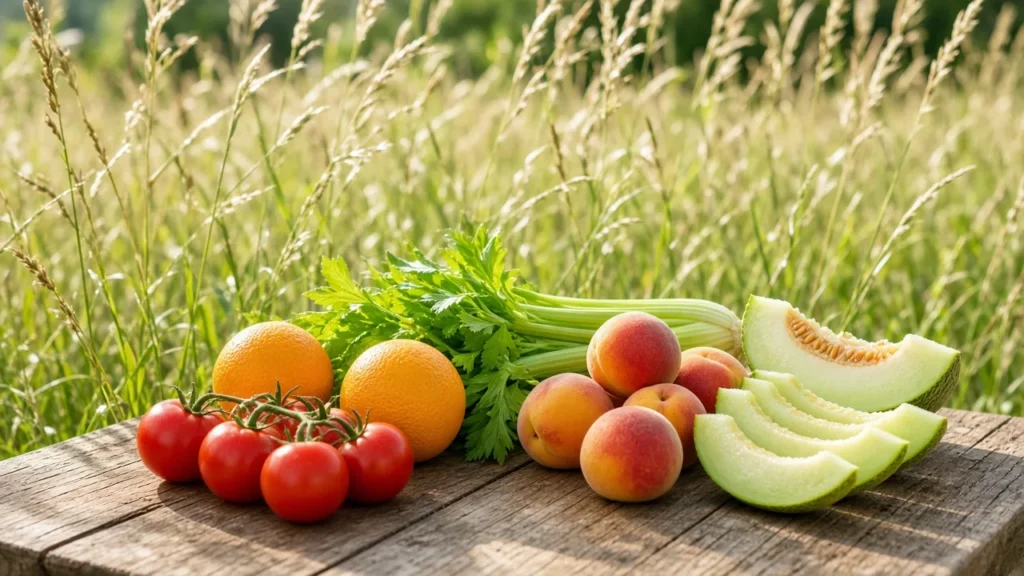
ACAAI lists celery, melons, oranges, peaches and tomato as foods commonly associated with grass pollen allergy (ACAAI). AAAAI names peaches, celery, tomatoes, melons (cantaloupe, watermelon and honeydew) and oranges (AAAAI).
| Food | Where it shows up | Easier option |
|---|---|---|
| Tomato | Salads, salsa, sandwiches, bruschetta | Cooked sauces, soups and roasted tomatoes |
| Melons (cantaloupe, honeydew, watermelon) | Fruit salads, smoothies, breakfast buffets | Often easiest to skip in grass season |
| Orange | Fresh segments, fresh-squeezed juice | Ask your allergist; try small amounts at home |
| Peach | Fresh fruit, smoothies, desserts | Canned or baked peaches |
| Celery | Veggie trays, salads, juices | Cooked in soups and stews |
Not everyone with a grass allergy reacts to these foods, and some people react to just one (ACAAI). Some overlap with other pollens: melon is also on the ragweed list, and peach and celery are on the birch list (ACAAI). If you’re allergic to more than one pollen, you may notice symptoms across several seasons. See our guides to birch pollen food allergy and ragweed food allergy.
What a Grass-Related Reaction Feels Like
Symptoms are the same as other types of OAS: an itchy mouth, a scratchy throat, or swelling of the lips, mouth, tongue and throat. Some people also get itchy ears or hives around the mouth (ACAAI).
- Tingling lips or tongue after a raw tomato or slice of melon
- Itchy roof of the mouth or throat
- Mild swelling of the lips
- Itchy ears
These symptoms usually begin right after eating (AAAAI) and fade quickly once the food is swallowed or removed (ACAAI). MedlinePlus notes that the severity of the reaction can depend on how much of the food you eat (MedlinePlus).
Severe reactions are uncommon. Still, ACAAI cites a study in which PFAS progressed beyond the mouth in nearly 9% of patients and to anaphylactic shock in 1.7% (ACAAI).
When it’s an emergency
Call 911 right away if a food reaction spreads beyond your mouth or comes with trouble breathing or swallowing, throat tightness, a hoarse or whispered voice, hives across your body, vomiting, dizziness or fainting. These can be signs of anaphylaxis, which needs emergency care (MedlinePlus). If you’ve been prescribed epinephrine, use it immediately, then get emergency help (MedlinePlus).
Why Timing Matters: Grass Season
AAFA says grass pollen is most common from April through early June, but it can be found year-round in warmer parts of the country such as California, Texas and throughout the South (AAFA). AAAAI notes OAS often gets worse during the pollen season of the pollen involved (AAAAI).
That puts peak grass pollen right before tomato and melon season, so a raw tomato salad in June can be the moment people first connect the dots. If you live in the South or Southwest, a longer grass season can mean a longer stretch of food reactions too. In Florida, for example, UF/IFAS notes grasses pollinate in spring, summer and fall (UF/IFAS); see our Florida pollen guide and our summer allergies guide.
AAFA lists the most common allergy-causing grasses as Bahia, Bermuda, fescue, Johnson, Kentucky blue, orchard, rye, sweet vernal and timothy (AAFA). Our city pollen pages show which grasses matter where you live.
How to Keep Enjoying Summer Produce
Heat is your friend. ACAAI says people with PFAS can usually eat the same fruits and vegetables cooked, because heat distorts the proteins so the immune system no longer recognizes them (ACAAI). AAAAI suggests baking or microwaving, choosing canned foods and peeling, since the problem protein is often concentrated in the skin (AAAAI).
- Tomatoes: try cooked tomato sauce, roasted tomatoes or tomato soup instead of raw slices.
- Peaches: canned peaches or a baked peach crisp are often tolerated.
- Celery: cooked in soups, stews and stir-fries rather than raw sticks.
- Melons: hard to cook, so ACAAI notes you may choose to skip foods like melon if symptoms are bothersome (ACAAI).
- Oranges: if fresh oranges bother you, talk with your allergist before experimenting with other forms.
A summer menu that works
Grill peaches for dessert, roast cherry tomatoes for pasta, and add celery to a cooked soup. You keep the seasonal flavor without the raw proteins that trigger OAS.
Where Grass Trigger Foods Hide
Raw grass-related foods are common in summer meals and drinks. Keep an eye out for:
- Salsa, pico de gallo, gazpacho and bruschetta (raw tomato)
- Fresh-squeezed orange juice and citrus salads
- Melon in fruit salads, smoothies and infused water
- Celery in green juices, chicken salad and veggie trays
- Fresh peaches in smoothies, salads and summer desserts
When eating out, ask whether a dish uses raw or cooked tomatoes and fruit. If you try a new raw food, start with a small bite at home rather than a big serving at a party.
Who Notices It Most
ACAAI says PFAS usually doesn’t appear in young children and is more common in older children, teens and young adults, often in people who have eaten the food for years without problems (ACAAI). That’s also the age group spending long summer days on grass fields, at camps and at cookouts, where raw fruit and tomato-heavy dishes are everywhere.
If your teen mentions that watermelon or salsa makes their mouth itch, write down the food and the month, and bring it up at their next checkup. Kids should know that a tingly mouth is a reason to stop eating and tell an adult. Our guide to allergies in teens has more tips for families.
Is It OAS or Something Else?
OAS is usually a mild reaction that stays in the mouth. A true food allergy can cause body-wide symptoms such as hives, a hoarse voice, wheezing, swelling of the face and tongue, stomach cramps, vomiting and dizziness (MedlinePlus). If cooked versions of a food also cause symptoms, or if reactions go beyond your mouth, AAAAI recommends talking with your doctor (AAAAI).
There’s no definitive test for OAS. Allergists combine your history with skin or blood tests for pollen (AAAAI), and sometimes skin prick tests or supervised oral food challenges with the raw food (ACAAI). Our allergy testing guide explains the options.
Treating the Grass Allergy Behind It
Mouth symptoms usually go away on their own within minutes, so ACAAI notes treatment usually isn’t needed for the reaction itself (ACAAI). Treating your grass allergy can still make late spring and summer easier:
- Daily allergy medicines. AAFA says most treatments work best when started at least 2 weeks before pollen season (AAFA). Compare options in Antihistamine Pills vs. Nasal Sprays.
- Under-the-tongue tablets. AAFA notes the FDA has approved under-the-tongue tablets for grass pollen allergy, taken daily before and during grass season (AAFA).
- Allergy shots. AAAAI says some studies have shown allergy shots can improve OAS symptoms (AAAAI).
- Less pollen exposure. Let someone else mow, keep windows closed on high-count days and shower after outdoor time. Our pollen mask guide helps if you do the yard work.
When to See an Allergist
See an allergist if your throat feels very uncomfortable, symptoms are getting worse, cooked foods or nuts cause symptoms, or you’ve had hives, vomiting or trouble breathing after eating raw fruits or vegetables (AAAAI). If you’ve had a reaction beyond your mouth, your allergist may prescribe an epinephrine auto-injector (ACAAI). Find a board-certified specialist near you in our allergist directory.
What actually helps
We may earn a commission from qualifying purchases. Read our affiliate disclosure.
HEPA air purifier & filters
A portable HEPA purifier sized to the room can lower airborne particles such as pollen and dust; it only works if you replace filters on schedule. (EPA: Guide to Air Cleaners in the Home)
See the Levoit Core 300 on AmazonSaline nasal rinse kit
Rinsing with saline can clear pollen from the nose; use distilled, sterile or boiled-then-cooled water, never plain tap water. (FDA: Is rinsing your sinuses with neti pots safe?)
See the NeilMed Sinus Rinse kit on AmazonN95 mask for yard work
For mowing, raking or gardening in pollen season, a well-fitted N95 respirator filters airborne particles far better than a loose face mask. Check with a doctor first if you have a breathing condition. (FDA: N95 Respirators and Face Masks)
See the 3M Aura 9205+ N95 on AmazonMore on pollen and food: Birch pollen food allergy, Oral allergy syndrome and Ragweed food allergy.
Written by: SeasonalAllergies.org Editorial Team (October 27, 2026)
This article is for general education and is not medical advice. Food reactions can be serious. Talk with your doctor or a board-certified allergist before avoiding or reintroducing foods, especially for children. Call 911 for trouble breathing, throat tightness, a hoarse voice, fainting or any reaction beyond the mouth.
Grass Pollen Food Allergy FAQs
Which foods cross-react with grass pollen?
Celery, melons, oranges, peaches and tomato are the most commonly listed (ACAAI).
Why do raw tomatoes make my mouth itch?
If you’re allergic to grass pollen, proteins in raw tomato can resemble grass proteins and trigger oral allergy syndrome (AAAAI).
Can I eat tomato sauce if raw tomatoes bother me?
Often, yes. Cooking breaks down the proteins behind OAS (ACAAI).
When is grass pollen season?
Mostly April through early June, but year-round in warm parts of the country (AAFA).
Is there a tablet for grass allergy?
Yes. AAFA notes FDA-approved under-the-tongue tablets for grass pollen allergy (AAFA). Ask an allergist if they’re right for you.
When is a grass-related food reaction an emergency?
Call 911 for trouble breathing, throat tightness, a hoarse voice, fainting or symptoms beyond the mouth (MedlinePlus).
Related Guides
Local pollen and allergist guides
Pollen seasons and triggers change by city. See what is in the air near you and where to find an allergist.
City pollen guides
Sources
- American College of Allergy, Asthma and Immunology. “Pollen Food Allergy Syndrome.”
https://acaai.org/allergies/allergic-conditions/food/oral-allergy-syndrome/ - Asthma and Allergy Foundation of America. “Pollen Allergy.”
https://aafa.org/allergies/types-of-allergies/pollen-allergy/ - American Academy of Allergy, Asthma & Immunology. “Oral Allergy Syndrome (OAS) or Pollen Food Syndrome.”
https://www.aaaai.org/tools-for-the-public/conditions-library/allergies/oral-allergy-syndrome-(oas) - MedlinePlus Medical Encyclopedia. “Anaphylaxis.” U.S. National Library of Medicine.
https://medlineplus.gov/ency/article/000844.htm - MedlinePlus Medical Encyclopedia. “Food allergy.” U.S. National Library of Medicine.
https://medlineplus.gov/ency/article/000817.htm - University of Florida IFAS Gardening Solutions. “Pollen and Allergies.”
https://gardeningsolutions.ifas.ufl.edu/design/outdoor-living/pollen-and-allergies/
🌼 Free pollen alerts
Short, sourced alerts when oak, grass, ragweed or mold season picks up near you. Sign up and get our free printable US and Florida pollen calendar.
Free printable pollen calendar included. No spam. Unsubscribe anytime.