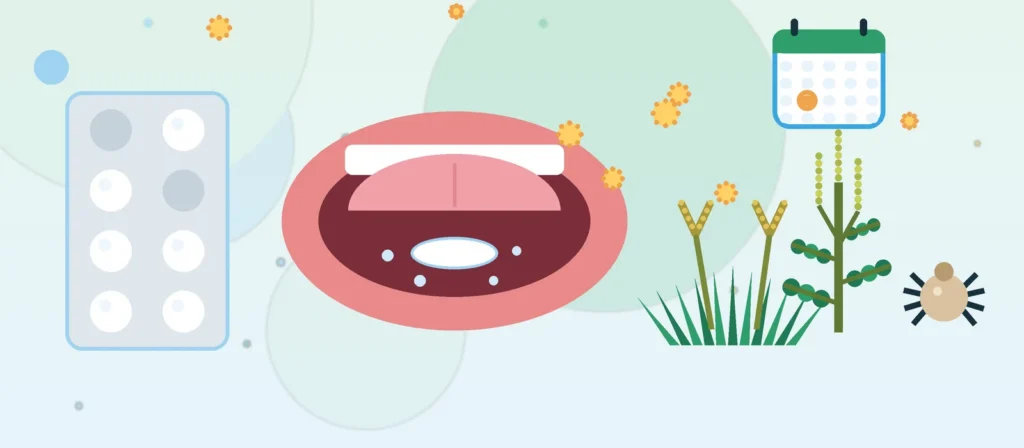
If daily pills and sprays only take the edge off your allergies, you may have heard about allergy tablets that dissolve under your tongue. This treatment, called sublingual immunotherapy (SLIT), works differently from regular allergy medicine. Instead of blocking symptoms for a day, it slowly trains your immune system to react less to one specific allergen. Late fall is a good time to learn about it, because grass pollen tablets must be started months before spring.
Key takeaways
- The FDA has approved four allergy tablets: Grastek and Oralair for grass pollen, Ragwitek for short ragweed and Odactra for house dust mites (AAAAI).
- Each tablet treats only the allergen it contains, so it will not help with other triggers such as trees or pets (AAAAI).
- Pollen tablets are started months before the season: at least 12 weeks ahead for Grastek and Ragwitek (Grastek label) (Ragwitek label) and 4 months ahead for Oralair (Oralair label).
- Your first dose is taken at a doctor’s office with at least 30 minutes of observation, and you will be prescribed an epinephrine auto-injector for home (Grastek label).
- Allergy drops are not FDA-approved and are used off-label in the United States (ACAAI).
What Under-the-Tongue Allergy Tablets Are
Allergy tablets are a form of allergen immunotherapy, the same idea behind allergy shots. You take a small, steady dose of the thing you are allergic to, and over time your body builds tolerance so symptoms ease. ACAAI explains that the tablets are placed under the tongue for one to two minutes and then swallowed as they dissolve, and that they increase your tolerance to the allergen and reduce symptoms over time (ACAAI).
Antihistamines and nasal steroid sprays help only while you take them. The tablet labels say plainly that they are not meant for the immediate relief of allergy symptoms (Grastek label), so you will usually keep your regular medicines on hand, especially early in treatment. For a broader look at how immunotherapy works, including allergy shots, see our allergy immunotherapy guide.
AAAAI notes that allergy tablets are similar to allergy shots in how well they control symptoms, and that both have been shown to provide long-term improvement even after treatment ends (AAAAI).
The Four FDA-Approved Allergy Tablets
Only four allergy tablets are approved in the United States. Each targets one type of allergy, and the current prescribing information approves each for people 5 through 65 years of age.
- Grastek contains Timothy grass pollen. It treats grass pollen allergic rhinitis, with or without eye symptoms, in people whose testing confirms an allergy to Timothy grass or cross-reactive grass pollens (Grastek label).
- Oralair contains a mix of five grass pollens: sweet vernal, orchard, perennial rye, Timothy and Kentucky blue grass. It treats grass pollen allergy confirmed by testing to any of those five grasses (Oralair label).
- Ragwitek contains short ragweed pollen and treats ragweed allergy confirmed by a skin or blood test (Ragwitek label).
- Odactra treats house dust mite allergy confirmed by testing to the two common dust mite species (Odactra label).
ACAAI describes the grass products as tablets for northern pasture grasses like Timothy (ACAAI). If you live somewhere warm, the grasses that bother you most may be different, so ask your allergist whether a grass tablet fits your test results. Our grass pollen allergy treatment guide covers other options, and the ragweed allergy treatment guide explains ragweed season dates and relief.
One allergen per tablet
AAAAI points out that immunotherapy only works for the allergen it contains. If you are allergic to ragweed and trees, a ragweed tablet would only help during ragweed season (AAAAI). ACAAI adds that most people with allergies react to more than one allergen, and allergy shots can treat several at once, including trees, grass, weeds, mold, dust, pet dander and insect stings (ACAAI).
How You Take Them
Allergy tablets require a prescription, and testing comes first. ACAAI says an allergist must first use allergy testing to confirm your sensitivities before a tablet is prescribed (ACAAI). Our allergy testing guide explains what that involves, and skin prick vs. blood allergy tests compares the two main methods.
The labels give the same basic routine for each tablet:
- First dose at the office. You take your first tablet under the supervision of a doctor experienced in allergic diseases and stay for at least 30 minutes so the staff can watch for a reaction (Grastek label).
- One tablet a day at home after that. Place it under your tongue and let it dissolve completely. Do not swallow for at least 1 minute (Grastek label).
- No food or drink around the dose. Do not take the tablet with food or a beverage, and wait 5 minutes afterward before eating or drinking. (Odactra label).
- Keep epinephrine available. Your doctor will prescribe an epinephrine auto-injector and teach you how to use it (Grastek label).
The labels say data on restarting after a missed dose are limited, and that in the clinical trials, breaks of up to seven days were allowed (Grastek label). ACAAI also says you should get clear guidance on managing reactions and treatment interruptions, and know when to contact your allergist (ACAAI).
When to Start and How Long Treatment Lasts
Timing is the part people most often miss. Pollen tablets are not something you start when your eyes begin to itch:
- Grastek: start at least 12 weeks before the expected start of each grass pollen season and continue through the season. For lasting benefit for one grass season after you stop, it may be taken daily for three straight years, including between seasons (Grastek label).
- Oralair: start 4 months before the expected start of each grass pollen season and continue through the season (Oralair label).
- Ragwitek: start at least 12 weeks before the expected start of ragweed season and continue through the season (Ragwitek label).
- Odactra: dust mites are an indoor, year-round allergen, and ACAAI says the dust mite tablet is taken year-round (ACAAI).
ACAAI notes that therapy is generally recommended for three to five years to build lasting tolerance, and that the length depends on which tablet you take and your allergist’s advice (ACAAI). To match a start date to your local season, check our pollen calendar by month and region. If dust mites are your main trigger, our article on dust mite allergy in winter covers steps you can take at home while you decide on treatment.
Side Effects and Who Should Not Take Them
Most side effects are in the mouth and throat. AAAAI says the main side effects are itching or burning of the mouth or lips and, less often, stomach symptoms, and that these usually stop after a few days or a week (AAAAI). In the Grastek trials, the most common reactions were an itchy mouth (26.7% vs. 3.5% on placebo), throat irritation (22.6% vs. 2.8%), itchy ears (12.5% vs. 1.1%) and mouth swelling (11.1% vs. 0.8%) (Grastek label).
Serious reactions are rare but possible. Each tablet’s label carries a boxed warning that it can cause life-threatening allergic reactions such as anaphylaxis and severe throat swelling (Ragwitek label) (Odactra label). AAAAI says the tablets have a more favorable safety profile than allergy shots, which is why only the first dose needs a medical setting (AAAAI).
According to the labels, you should not take these tablets if you have (Grastek label):
- Severe, unstable or uncontrolled asthma
- A history of any severe systemic allergic reaction
- A history of a severe local reaction to any under-the-tongue immunotherapy
- A history of eosinophilic esophagitis, an inflammatory condition of the esophagus
- An allergy to any of the tablet’s inactive ingredients
The labels also say the tablets may not be suitable if you have a condition that could make a serious reaction harder to survive, or if you take medicines such as beta-blockers that can make epinephrine or inhaled bronchodilators work less well (Grastek label). If you have a mouth sore or inflammation, the labels say to stop treatment until your mouth heals (Grastek label). Because asthma affects your eligibility, our article on pollen and asthma is worth reading if you wheeze during allergy season.
Allergy Tablets vs. Allergy Shots vs. Drops
Tablets let you skip regular office visits for shots, in exchange for a daily routine at home. If you are comparing the two, our breakdown of allergy shot cost explains the visit schedule and what you may pay.
Under-the-tongue drops are a separate category. ACAAI says allergy drops are not FDA-approved, are off-label in the United States, and are not covered by most insurance, Medicare or Medicaid (ACAAI). AAAAI adds that the effectiveness of U.S. allergen extract drops is still under investigation and that the effectiveness of mixing several allergens in drops is not known (AAAAI).
When to See an Allergist
You do not need to wait until your allergies are severe. ACAAI recommends seeing an allergist if (ACAAI):
- Your allergies cause symptoms such as chronic sinus infections, nasal congestion or difficulty breathing.
- You have hay fever or other allergy symptoms several months of the year.
- Antihistamines and other over-the-counter medicines do not control your symptoms or cause side effects you cannot accept, such as drowsiness.
- Your asthma or allergies get in the way of daily activities or lower your quality of life.
- You have warning signs of serious asthma, such as struggling to catch your breath, frequent wheezing or coughing at night or after exercise, or frequent shortness of breath or chest tightness.
A visit usually includes allergy testing, advice on avoiding triggers, prescriptions, and a discussion of immunotherapy such as shots or tablets (ACAAI). If you have tried the usual options in our guide to the best allergy medicines for pollen season without enough relief, that is useful information for your allergist. When you are ready, use our Find an Allergist directory to find a board-certified allergist close to home.
Written by: SeasonalAllergies.org Editorial Team (November 18, 2026)
This article is for general education and is not medical advice. Talk with your doctor or an allergist about your symptoms before starting, stopping or changing any treatment.
Under-the-Tongue Allergy Tablet FAQs
Can you buy allergy tablets over the counter?
No. Grastek, Oralair, Ragwitek and Odactra require a prescription, and your allergy must be confirmed by a skin or blood test first (ACAAI). Your first dose is given in a doctor’s office with at least 30 minutes of observation (Grastek label).
How long before allergy tablets start working?
They work gradually, not right away. The labels say the tablets are not for immediate symptom relief, and pollen tablets are started at least 12 weeks before the season (Ragwitek label). ACAAI says treatment is generally continued for three to five years for lasting benefit (ACAAI).
Do allergy tablets work for pet or tree pollen allergies?
Not the approved ones. The four FDA-approved tablets cover only grass pollen, short ragweed and house dust mites (AAAAI). Allergy shots, by contrast, can treat trees, pet dander and several other allergens (ACAAI). Our guide to allergy shots for pet allergies explains that route.
Related Guides
Local pollen and allergist guides
Pollen seasons and triggers change by city. See what is in the air near you and where to find an allergist.
City pollen guides
State guides
Sources
- American Academy of Allergy, Asthma & Immunology. “SLIT Treatment for Allergic Rhinitis: Nothing to Sneeze About.”
https://www.aaaai.org/tools-for-the-public/conditions-library/allergies/slit-treatment-for-allergic-rhinitis-nothing-to-sn - DailyMed, U.S. National Library of Medicine. “Grastek (Timothy grass pollen allergen extract) tablet: prescribing information.”
https://dailymed.nlm.nih.gov/dailymed/drugInfo.cfm?setid=ebb02ba7-de81-4367-8ba7-d774816f85b0 - DailyMed, U.S. National Library of Medicine. “Ragwitek (short ragweed pollen allergen extract) tablet: prescribing information.”
https://dailymed.nlm.nih.gov/dailymed/drugInfo.cfm?setid=70216cba-11b5-40fd-8656-9f27b24f7b60 - DailyMed, U.S. National Library of Medicine. “Oralair (sweet vernal, orchard, perennial rye, timothy and Kentucky blue grass mixed pollens allergen extract) tablet: prescribing information.”
https://dailymed.nlm.nih.gov/dailymed/drugInfo.cfm?setid=854c9772-63b9-44a3-a11e-77b29c59e91d - American College of Allergy, Asthma & Immunology. “Immunotherapy with Allergy Tablets.”
https://acaai.org/allergies/management-treatment/allergy-immunotherapy/immunotherapy-with-allergy-tablets/ - DailyMed, U.S. National Library of Medicine. “Odactra (house dust mite allergen extract) tablet: prescribing information.”
https://dailymed.nlm.nih.gov/dailymed/drugInfo.cfm?setid=71ca220d-78d5-47d4-be84-8d6e844b24b3 - American College of Allergy, Asthma & Immunology. “When to See an Allergist.”
https://acaai.org/do-you-need-an-allergist/when-to-see-an-allergist/
🌼 Free pollen alerts
Short, sourced alerts when oak, grass, ragweed or mold season picks up near you. Sign up and get our free printable US and Florida pollen calendar.
Free printable pollen calendar included. No spam. Unsubscribe anytime.